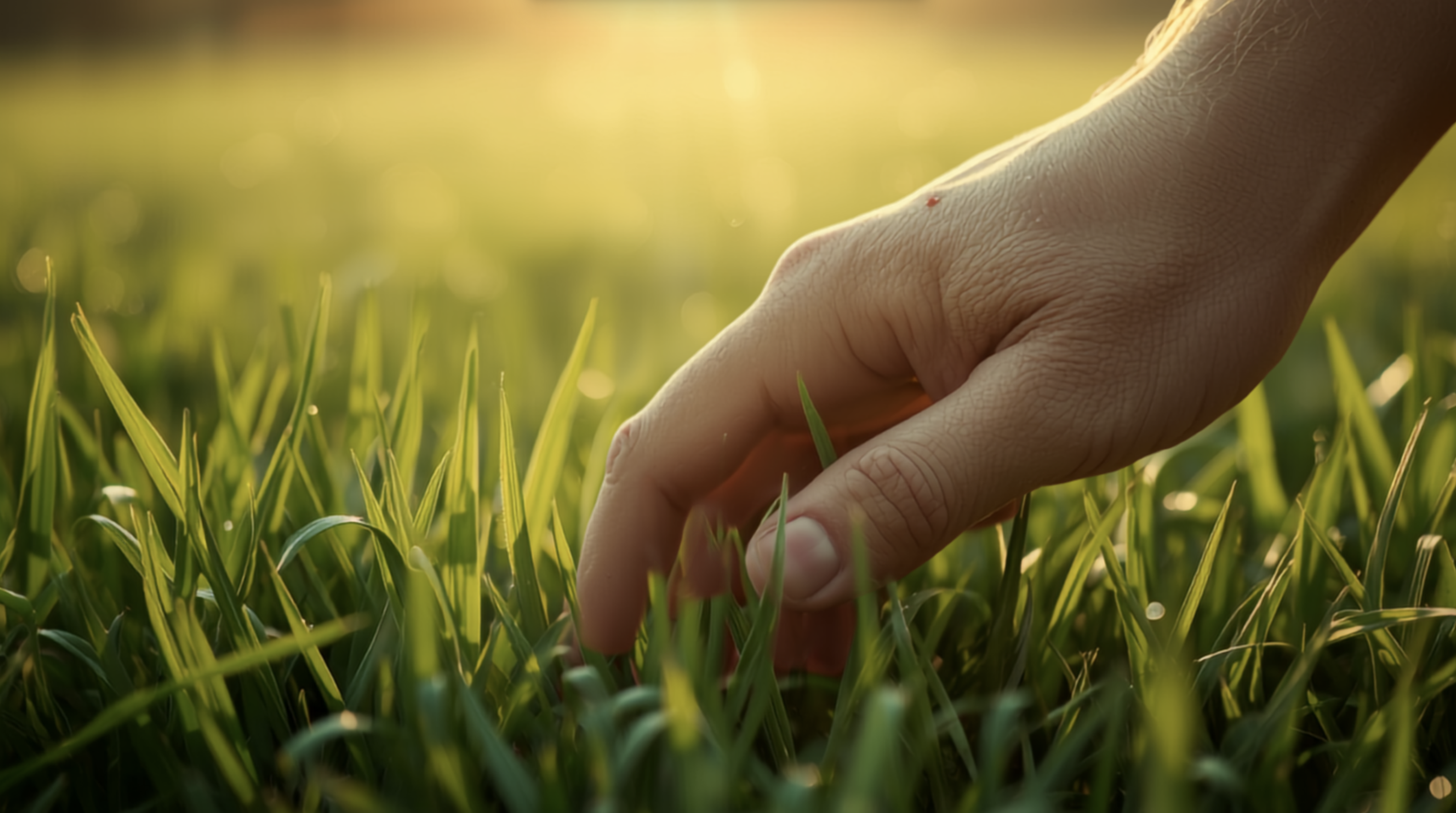
I Touched Grass- And So Should You
For the past few days, I’ve been thinking about what the theme of my next blog should be. What should the hook be? What profound piece of wisdom am I supposed to share this time? What life lesson have I learned that deserves an entire blog post? And honestly? I couldn’t think of one.
Not because nothing has happened. Actually, a lot has happened. But for once, I didn’t have a dramatic career lesson. I didn’t have a hardship story that needed to be turned into motivation. No rivers were crossed. No mountains were hiked. I didn’t have some major achievement to announce. Just a few uncomfortable decisions, a calculated risk, and a lot of figuring things out as I went.
I just kept thinking about how… good things have been.
And then I realized that maybe that’s the story.
We don’t always need a negative beginning to justify a positive ending. Sometimes, things are just good. And sometimes, the biggest thing you’ve achieved isn’t something you can put on your resume.
Sometimes, it’s peace.
A Zillennial at Peace
I always thought I would write my next blog post on the day I achieved something big.
A new job. A promotion. A career switch. A publication. Something measurable. Something I could point to and say, “Look, I did it.” Instead, I almost forgot that I had achieved something at all.
It wasn’t a metric. Neither a title nor a number. It was something I could only feel and experience.
It was ‘peace’.
At 28, as a researcher still trying to get my foot into the biotech industry, I am very much still building my career. I have goals, I have things I want to learn, and I have places I want to go. I still want to grow, and I don’t think that is ever going to stop.
But I also don’t want to spend my entire life chasing one thing after another. There is a difference between being comfortable and being content. I don’t want to become so comfortable that I lose the motivation to grow. That kind of comfort can kill your drive.
But I also don’t want to become so obsessed with the next milestone that I forget to enjoy the life I have already built. I think I’m finally learning how to do both. I have to keep moving, but also sit back sometimes, relax, and touch some grass.
I hit the Restart button
Last year in December, I had an opportunity to visit Boston for research training and learn a few techniques to upskill my cell culture knowledge. Boston was good. I had always imagined that I would have the best time there.
Except it was winter. It was cold, snowy, and just dark. And most of my days looked something like:
Work.
Hotel.
Netflix.
Sleep.
Repeat.
I did step outside, though. All layered up and trying to explore a little. But I wasn’t feeling my best. The very next month, I went back to India to see my family, spent time with them, and came back with a lot of clarity.
Sometimes you don’t realize how much you’ve been putting off until you finally step away from your routine. I started looking at my life differently. There were things I had been telling myself I would deal with eventually. When things got better. When work got better. When I had more money. When I had a car. When I figured things out.
Eventually.
That magical word we use when we don’t know what to do right now. And I realized I couldn’t keep waiting for “eventually.” I had to restart my life.
There were a lot of things happening simultaneously during that period, and some of the hardest decisions I made had nothing to do with my career. I had to accept that some parts of the life I had built were no longer the life I wanted to continue living. Starting over sounds exciting when you say it retrospectively. Living through it requires a lot more courage.
I was 27, working, still living in a student apartment, without my own means of commuting, with very little social life, and I had become too accustomed to simply getting through the day. I would stay up late at work, just to avoid coming back to an empty apartment, cooking meals for myself and putting myself to sleep. I realised I wasn’t happy. Be it my apartment or a hotel, the routine was still the same, and it was not a good feeling.
Coming to the United States is not easy. There are so many things you have to figure out while simultaneously trying to grow from a student into a working professional. And when you’re doing it largely on your own, there is no instruction manual. At some point, I realized that I had spent so much energy waiting for circumstances to change that I had stopped asking myself what I could change.
And that required courage.
Not confidence.
Courage.
Because confidence comes from knowing you can handle something. Courage is deciding to do it when you aren’t entirely sure that you can.
Moving out meant figuring out where I would live. It meant getting a car. It meant becoming more independent. It meant accepting that I was entering a completely different phase of my life. None of those things were impossible. I just wasn’t ready to get on that rollercoaster.
Eventually, I reached a point where staying where I was felt harder than taking the risk of leaving. So I took what I would call a calculated risk. I didn’t have a perfect plan. I didn’t know exactly how everything would work out.
But once I finally made the decision to move, something strange happened. Things started falling into place.
One thing at a time
Within a few months, I moved into a beautiful apartment. I bought myself a new car. My social life improved. My parents could visit me in the United States. I checked a few things off my bucket list.
I started feeling independent in a way I hadn’t experienced before. And somewhere in all of that, I became more organized in my thoughts. More organized at work. Clearer about what I want. More in charge of my own life. I don’t think any of these things happened because I suddenly figured life out. They happened because I finally started making decisions. And this is something I wish more people, especially people in their twenties, would hear:
You don’t have to complete your entire bucket list in one go.
You don’t have to have the career, the relationship, the money, the perfect apartment, the perfect social life, the next degree, and the five-year plan all at the same time.
One thing at a time.
Your life is allowed to move at different speeds.
Right now, I feel like I’m winning on my personal end while I’m still working on my professional end. Tomorrow I might feel the opposite. Maybe my experiments will be going amazingly well, but something else in my personal life will feel uncertain.
Maybe I’ll have the career breakthrough I’ve been working toward and still feel like another part of my life needs attention.
So how do I measure that day? As a success? Or a failure?
I’ve realized I don’t want to measure my entire life that way anymore. Not every part of your life has to be winning at the same time for your life to be a good one.
How to make an easy job difficult?
Of course, I am still a researcher. Which means that just when I thought I had figured out life, my experiments decided to humble me.
I became much more organized and clear at work over the past few months, but that doesn’t mean everything suddenly became easy. A few months ago, I was trying to optimize a basic cell viability assay protocol.
And I failed. Again. And again. And again.
I ended up doing essentially the same experiment almost nine times with no success. I spoke to people. I contacted the technical team. I read countless articles. I changed things. I debated things. I tried different approaches. I seeded cells in multiple densities in multiple plates, multiple times. I did everything I could think of. And the readings were still all over the place.
At this point, I was convinced there had to be some complicated technical explanation. Or the same old impostor syndrome; I thought I was the problem.
Then, one fine day, I was reading my plate for what felt like the tenth time. One of my colleagues looked at it and said something along the lines of:
“Your readings are all over the place because you have a lid on the plate.”
I looked at the plate. I looked at the lid. And then I realized that I had marked a few wells on the lid with a Sharpie.
The reader was reading the Sharpie. So I casually took the lid off.
Boom.
I got my readings. I almost had tears in my eyes. Not because the experiment worked.
Because for the past few months, I had been trying to optimize a protocol that had absolutely nothing to do with what was actually wrong.
The problem was the lid.
THE LID.
After all the papers. All the troubleshooting. All the technical conversations. All the repeated experiments. All the time.
The damn lid.
At that moment, I felt incredibly stupid. Everyone around me was consoling me.
“It’s just an experiment.”
“It’s okay.”
“That’s why research takes so much time.”
And they’re right. It is an experiment. That’s literally the point. But I wasn’t angry because the experiment failed. I was frustrated because I kept trying to solve the wrong problem. If I had known earlier, I could have saved weeks of work and moved on to the next phase of the project much sooner. And a part of me still thinks about those months. But another part of me is grateful. Because at least I found the root cause. And more importantly, it reminded me of something that I think applies to much more than research.
Sometimes you don’t need to work harder – yes, I said it
Sometimes you just need to take the lid off.
We are so conditioned to think that if something isn’t working, the answer must be more effort.
Work harder. Read more. Learn more. Apply to more jobs. Network more. Optimize your resume again. Take another course. Do more. And more. And more.
And sometimes, yes, you need to put in the work. But sometimes you’ve been staring at the same problem from the same angle for so long that you don’t even realize you’re looking at the wrong thing.
Sometimes you don’t need more effort. You need a different perspective.
And sometimes, the thing standing between you and the result you want is something so ridiculously simple that you won’t believe you missed it.
Like a Sharpie on a plate lid.
Or like staying in a situation simply because you’re afraid of what happens after you leave it. Or like putting your entire life on hold until your career works out. Or waiting for the perfect time to start.
The courage to move
Looking back, I think courage was the bridge between where I was and where I wanted to be.
Not certainty. Not having everything figured out. Not knowing exactly how the next six months would look. Just courage. It won’t make everything perfect, but possible.
That’s an important distinction.
I don’t think starting over means suddenly having a beautiful new life. It means allowing yourself to build one. And I honestly cannot imagine how much I have changed for the better in the past few months. The version of me who was sitting there months ago could not have imagined this version of my life. And that makes me incredibly grateful.
I don’t want to hate the present while building the future
I still want more. I want to grow professionally, and I want to transition further into biotech. I want to keep learning, challenge myself, and build a career that I’m proud of.
None of that has changed.
But I don’t want to spend the next five years being miserable while waiting for the next five years to begin. I don’t want to keep chasing one milestone after another and only allow myself to feel successful once I reach the next one. I want to enjoy what I have built while continuing to build. I want to take my bucket list one thing at a time. I want to balance my professional and personal life today instead of waiting for some imaginary future where everything is perfectly balanced. Because the truth is, tomorrow might look completely different.
Maybe I’ll be having the best professional year of my life and something personal won’t be going the way I hoped. Maybe my personal life will be amazing while my career feels uncertain. Maybe both will be great. Maybe neither will be. And I don’t want my definition of success to change every morning depending on which part of my life is doing well. I think success can also be waking up and feeling at peace with the life you’re living.
I’m living the dream of a younger me
I sometimes have to remind myself that I am living parts of the life my 22-year-old self dreamt about.
For now, I’m still climbing. Still working. If you ask me, honestly, I’m still waiting for my first first-author publication to come out since I worked so hard for it. I’m still in the process of getting a good chunk of data on my current project to get my paper published in a good journal. I’m still waking up just to repeat the experiments at work. But I’m still showing up, and I think that’s what counts, isn’t it?
My Two Cents
Competition will always be there. Stress will never go away. But the moment you start looking at competition as eustress and not distress — I can safely say you’ve cracked part of the code.
Because this is a journey where you’re allowed to walk at different speeds. You can stop and appreciate the view. You can keep running. You can slow down, change direction, take a break, and then start running again. Because honestly, the finish line is only going to keep moving farther and farther away.
If you ask me, I’ll keep running. But I’m also going to stop every once in a while, look around, and appreciate the view.
Because peace is an achievement too.
And apparently, sometimes the answer is just to take the lid off.
And touch some grass.